
Where Trauma Becomes Resilience: The Work of CSC-Asbl in Uvira, Eastern DR Congo
For the women and youth of South Kivu, healing is not a destination. It is something built, program by program, season by season, inside one of the world's most active conflict zones.
About the Author: HUMANDREAM Staff

For the women and youth of South Kivu, healing is not a destination. It is something built, program by program, season by season, inside one of the world’s most active conflict zones.
The City and the People Inside the Crisis
In December 2025, at least 32 schools in Uvira halted classes to shelter families who had nowhere else to go. The World Food Program suspended operations across South Kivu, cutting 25,000 people from food support, and armed conflict had reached the city itself. South Kivu’s subnational Human Development Index stands at 0.532, placing it in the low human development category according to the UNDP, and by March 2025 UNICEF had documented more than 850,000 people displaced across the province, with nearly half of them children, as verified grave violations against children rose by approximately 150 percent since January 2025. This is not background context. This is the environment in which Community Support Center, known as CSC-Asbl, does its work every day.
Byolenganya Olo Bernoulli was born into this same province. From age three to twelve, a visible skin condition left him excluded, rejected, and invisible to the peers around him. He trained as a civil engineer and chose instead to build something else. In 2016, at 21 years old, he founded CSC-Asbl in Uvira with a conviction that still anchors every program it runs: no child should ever feel forgotten. The crisis he grew up inside became the blueprint for what he built in response.
What CSC-Asbl Built, and for Whom
CSC-Asbl places women and girls at the center of every program it designs while deliberately engaging men, boys, and whole communities as active partners in transformation. Evidence from the World Bank’s STAR-Est program in eastern DRC confirms that effective response to gender-based violence in this geography requires exactly this kind of integrated approach: direct survivor services, economic empowerment to address poverty and food insecurity as structural drivers of vulnerability, and prevention programming that shifts norms at the individual, household, and community levels. In South Kivu, a whole-community model is not a dilution of women-focus. It is what the evidence from this exact geography requires, and CSC-Asbl’s programming reflects that evidence base. The outcomes document it: in the Play4Peace and Mental Health Support program, known as P4PM, girls’ participation grew from 10 percent in 2023 to 56 percent among 785 participants in 2025, a shift that happened because the program reached the community around those girls, not only the girls themselves.
That shift did not happen in isolation. It happened alongside EmpowerHer, which has brought 50 women and girls through entrepreneurship and leadership training, building the economic agency and self-determination that conflict systematically removes. Safi is 14 years old and one of those graduates. “Before joining EmpowerHer, I thought certain opportunities were only for boys,” she says. “Now I’m not only learning leadership but also teaching my younger sister to aim high.” Her journey from assumption to agency is what gender-responsive programming looks like when it reaches the generation it was built to change.
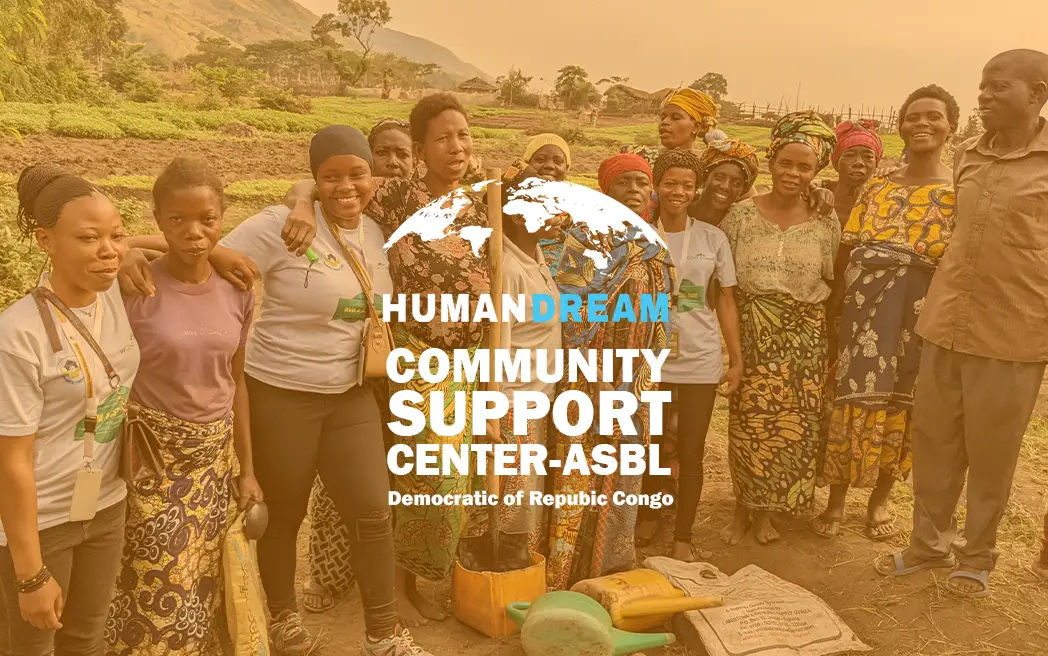
For women carrying the full weight of displacement, the PAFA agricultural livelihoods program reaches 50 women in Kitundu IDP Camp and 47 more in the Kawizi community, providing the training, tools, and knowledge to rebuild food security and generate income from the land available to them. Birimwana farms in Kitundu Camp. “PAFA has transformed my approach to farming,” she says. “I now understand how to protect the soil, and my harvests have improved. This project is a lifeline for us women farmers.” Alongside PAFA, the Seed the Future agroforestry initiative has planted 100 fruit trees in its pilot phase, creating a productive asset base that generates harvest income across seasons while restoring degraded land. Camp-based services at Kitundu deliver education support and child protection to families whose children would otherwise have access to neither. Across all program streams, CSC-Asbl is actively working toward reaching 200 additional women over the coming 18 months.
Healing the wounds that conflict leaves behind requires a program of its own. CSC-Asbl’s Healing for Peace initiative, co-implemented with the Collective Leadership Institute and funded by the German Federal Foreign Office through the ifa (zivik) program, provides structured group therapy, safe dialogue spaces, and psychosocial support for IDP women and youth in Uvira, creating the conditions under which every other dimension of recovery becomes possible.
The Proof
In 2024, CSC-Asbl reached 3,724 women, children, and youth across its programs, with 96 cents of every dollar directed to program delivery. These are not projections. They are the documented results of a team that has built an institution of real consequence inside one of the world’s most active conflict zones.
The Bridge
HUMANDREAM Foundation, a minority- and woman-founded California 501(c)(3), serves as the institutional bridge connecting CSC-Asbl’s community-led work to international philanthropic resources, providing monitoring and evaluation infrastructure, financial accountability systems, and organizational capacity-building support. CSC-Asbl retains full authority over program design and community implementation, because organizations closest to the communities they serve are most responsive to their needs, and because locally led civil society in active conflict zones requires institutional infrastructure it should not have to build alone.
The work of CSC-Asbl is not a program waiting to scale. It is a community already rebuilding, supported by a team that has earned deep trust in some of the world’s most difficult conditions. What it needs is the partnership that allows it to keep going, deepen its reach, and demonstrate what locally led civil society can accomplish when resourced with intention.
By HUMANDREAM Foundation | humandream.org
Sources: UNICEF DRC (March 2025); UN News / OCHA (December 2025); World Food Programme; UNDP Subnational HDI, South Kivu; CSC-Asbl 2024 Annual Report and 2025 field program data.
Join the Movement
By clicking Sign Up, you agree to our Terms and Privacy Policy.