
Circular Food Economies
How HUMANDREAM Foundation is building the world's first governance architecture for circular food economies in the developing world — and why Kenya is where it begins.
About the Author: HUMANDREAM Staff

How HUMANDREAM Foundation is building the world’s first governance architecture for circular food economies in the developing world — and why Kenya is where it begins.
|
60–70% of Sub-Saharan African urban waste is organic — most landfilled today |
153 countries have no national food waste governance framework |
2–4 yrs until commercial operators establish African market presence |
5,000+ smallholder households to be served by Year 10 — Kenya first |
Every day, the cities of Sub-Saharan Africa send thousands of tonnes of organic food waste to landfill. In Nairobi alone, more than 2,400 tonnes of organic material arrive at Dandora landfill daily — rotting, generating methane, and forfeiting every nutrient and calorie embedded in that waste. A few hundred kilometres away, smallholder farmers in the Central Kenya corridor are paying fertiliser prices that have risen 60 to 120 percent since 2020, watching their soil degrade from decades of continuous monoculture, and struggling to afford the animal feed that makes livestock farming viable.
This is not a resource scarcity problem. It is a governance, logistics, and market design problem. The resources exist on both sides of the equation. What is missing is the architecture that connects them — and the institutional authority to ensure that architecture serves smallholder communities rather than commercial operators.
HUMANDREAM Foundation was built to create that architecture. And to create it before the market writes its own version.
The Governance Window That Is Closing
Only 21 countries had included food loss and waste reduction in their national climate plans as of 2022. One hundred and fifty-three countries have no national governance framework governing circular food systems. The regulatory standards that will determine how these markets develop — quality requirements, community access provisions, smallholder distribution mandates — have not yet been written in most of the world.
Commercial operators are not waiting. Private equity-backed Black Soldier Fly firms are evaluating African market entry within 2 to 4 years. Waste management multinationals already hold municipal contracts in Nairobi and Lagos. Fertiliser corporations are launching organic product lines using agro-dealer networks built over decades. These operators are not constrained by development mandates. They will serve the most profitable customers and write governance standards that reflect commercial, not community, interests.
|
The window to write development-mandate governance standards first is 3 to 7 years. HUMANDREAM’s mandate is to use that window — not observe it. |
Kenya First. The Developing World Next.
The structural misalignment HUMANDREAM addresses exists in identical form across the developing world. Dhaka, Karachi, Ho Chi Minh City, Kampala, Accra, Lima, and Medellín all face the same equation: cities generating organic waste they cannot manage, rural smallholders unable to afford the inputs they need to feed their communities. The governance architecture HUMANDREAM is building in Kenya is not an African solution. It is a global LMIC solution being proven in Africa first.
Every governance protocol HUMANDREAM develops — waste supply agreements, demand-side market development frameworks, technology sequencing triggers, mission-lock provisions — is published as an open standard that any city, government, or implementing organisation can adopt. The Nairobi hub validates them. Every subsequent replication strengthens their credibility as a global standard. The Open Protocol Library is the toolkit that converts Nairobi’s proof-of-concept into a replicable global architecture.
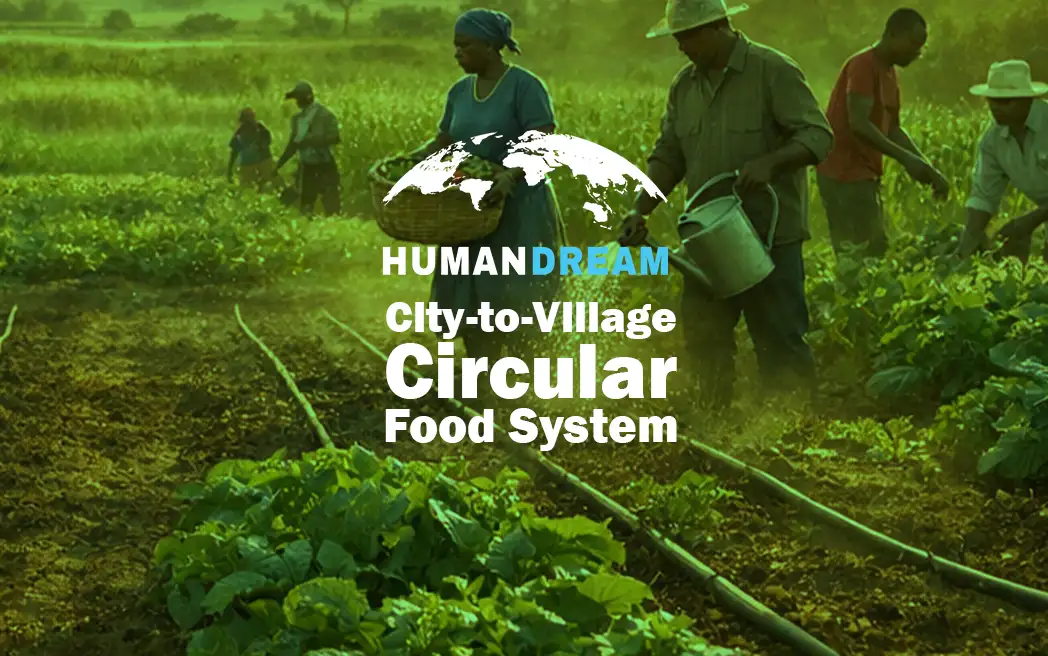
The City-to-Village Circular Food System
The CTVCFS model connects urban organic waste generators to rural smallholder farmers through a three-phase technology pathway and a hub-spoke-satellite spatial architecture. The Minimum Viable Hub is located in Nairobi. The Central Kenya rural corridor — Kiambu and Murang’a counties, 40 to 150 kilometres from central Nairobi — provides the smallholder demand base across three distance tiers.
Phase 1 launches with anaerobic digestion and composting. Urban organic waste is processed at the hub, producing KEBS-certified organic compost and liquid digestate distributed to smallholder farmers through cooperative societies. First revenue arrives at Month 4 to 6. KALRO field trials document yield improvement across 40 matched-pair plots. Twenty demonstration plots, managed by respected opinion-leader farmers, build the social proof that certified organic compost improves yields — the most powerful adoption mechanism available.
Phase 2a adds Black Soldier Fly insect protein meal for smallholder livestock feed — but only when a dedicated market scoping study confirms that corridor farmers are willing to pay at least 85 percent of the fishmeal competitor price. Phase 2b adds rural biogas cylinder distribution for household cooking fuel — but only when a logistics scoping study confirms delivery economics and household willingness-to-pay clear defined thresholds. These are not optional criteria. Technology activation follows demonstrated demand, not supply capability. This principle is written into the hub’s operating mandate as a constitutional provision — because premature capital deployment into unvalidated markets is the most common cause of financial failure in LMIC waste-to-value programmes.
The spatial architecture resolves a fundamental tension: the processing hub must be near urban waste sources, but farmers are dispersed across a rural hinterland extending 100 to 150 kilometres. Trucking heavy compost those distances generates transport emissions that partially offset the methane avoidance benefit. HUMANDREAM’s hub-spoke-satellite model solves this. The central hub processes waste and serves peri-urban farmers directly. Spoke distribution points at 40 to 80 kilometres, co-located with cooperative storage, receive bulk compost for bagging and retail. Satellite micro-composting units at 80 to 150 kilometres process local organic materials using hub digestate as a microbial inoculant, producing KALRO-certified compost inside the communities themselves. When a village produces certified compost under open HUMANDREAM protocols, the hub becomes a quality standard-setter — not a logistics operation. A county government can deploy fifty satellite units through existing extension infrastructure at a fraction of hub capital cost. That is how the model reaches every village.
The Design Challenge Every Prior Hub Has Understated
Every circular food hub design in Sub-Saharan Africa has made a structural assumption: that rural farmers will buy hub-produced organic inputs because those inputs are demonstrably better and cheaper than alternatives. This assumption is false in the short term — and treating it as true is the most common cause of financial failure in this sector.
Chemical fertiliser, despite its rising cost, has fundamental market advantages that hub compost cannot match at launch. Standardised bags with guaranteed nutrient content. Agro-dealers within walking distance. Application rates taught by extension officers. Decades of peer adoption evidence. Farmer scepticism about a new, unverified organic input is not irrational — it is a rational response to product unfamiliarity and quality uncertainty.
HUMANDREAM’s design resolves this systematically rather than assuming it away. KEBS nutrient certification converts every bag of hub compost from a variable informal product into a standardised certified agricultural input with guaranteed minimum N-P-K values, application rate guidance, and batch traceability — the same institutional quality assurance chemical fertiliser receives. KALRO demonstration plots, deliberately placing certified compost with opinion-leader farmers six months before commercial launch, build two growing seasons of yield evidence through the cooperative channels farmers already trust. The distribution channel is the cooperative the farmer already belongs to. And pricing in Years 1 and 2 is set below cost-plus, covered by donor market development budget, so that first adoption carries no financial risk for the farmer.
|
The model does not assume farmer adoption. It engineers it. |
Four Dimensions of Impact — Designed to Work Simultaneously
The CTVCFS model delivers across four dimensions not as sequential priorities but as integrated outcomes of a single coherent system.
Food security. Certified organic compost restores soil organic matter and drought resilience over multiple seasons. BSF insect protein at 30 percent below fishmeal prices makes smallholder poultry and dairy farming economically viable at income levels where it currently is not. A Household Dietary Diversity Score measurement instrument tracks the downstream food security impact from hub output to household nutrition — the first empirical food security impact chain for a LMIC circular food hub.
Employment and industry. Direct employment at hub, spoke, and satellite tiers — with a constitutional 50 percent women minimum across all roles. And market creation: before the hub exists, there is no commercial market for certified organic compost in the Central Kenya corridor. There is no smallholder insect protein feed market. There is no rural biogas cylinder refill infrastructure. The hub builds these markets from zero. When they mature, downstream enterprises — agro-vets stocking BSF meal, motorcycle cylinder delivery routes, cooperatives investing in bagging equipment — generate employment that the hub catalysed but does not directly count. An economic multiplier analysis will document the full corridor employment effect at Year 5.
Landfill climate impact. Three additive GHG reduction pathways: methane avoidance from diverting organic waste from open landfill; soil carbon sequestration through compost application; and avoided synthetic fertiliser production emissions, since Haber-Bosch nitrogen fixation is among the most energy-intensive industrial processes on earth. The hub-spoke-satellite architecture minimises transport emissions by eliminating long-haul direct delivery for Tier 3 communities. A net climate account, published at Month 12, will make this three-layer GHG case legible to ministers, AfDB board members, and GCF reviewers without requiring IPCC methodology literacy.
Global replicability. The Open Protocol Library publishes every governance standard as an open toolkit any city can adopt. A Global Replication Toolkit, developed at Months 18 to 24, adds a regulatory pathway assessment tool, a distribution architecture decision tree for contexts without Kenya’s cooperative density, and a tiered pricing framework for lower-income corridors. Eight candidate replication cities outside Africa — Dhaka, Ho Chi Minh City, Kampala, Medellín, Karachi, Lima, Yangon, and Addis Ababa — have been scored and ranked. Global LMIC framing opens UNDP Accelerator Labs, FAO Global Food Systems Programme, and World Bank P4G access that Africa-only framing cannot reach.
HUMANDREAM’s Role: Architect, Not Operator
HUMANDREAM Foundation is a California 501(c)(3) nonprofit — minority- and woman-founded — that operates as a collective impact backbone organisation. It does not directly manage hub operations. Sanergy, Nairobi’s leading waste-to-value operator, anchors Year 1 technical operations under a secondment agreement. KALRO anchors quality certification and field trials. KENAFF anchors cooperative society engagement and demand-side distribution across all three tiers. A Kenya-based program coordinator, hired when Tier 1 funding is confirmed, holds ground-level institutional relationships. The backbone role is powerful precisely because it does not compete with implementing partners — it coordinates them toward a shared governance standard that none could establish alone.
The mission-lock architecture protects smallholder community access in legal terms, not policy terms. A constitutional provision requires that a minimum of 60 percent of hub output goes to smallholder cooperatives at cost-plus pricing, and that any modification requires a two-thirds board supermajority including the affirmative vote of all cooperative board representatives. From Year 5, cooperatives may acquire 15 to 25 percent equity stakes in hub operations — converting community access from an institutional commitment into a legally enforceable property right held by the communities themselves. A commercial acquirer cannot extinguish a cooperative’s property rights.
Where We Are Today — and Why That Matters
HUMANDREAM is at pre-concept stage. The governance framework, technology sequencing, and demand-side architecture are fully developed. Operational execution begins when Phase 0 funding is confirmed. We are transparent about what exists and what remains to be built.
The Nairobi hub has not been built. Sanergy, KALRO, and KENAFF are the identified implementing partners — MOU conversations have not yet been initiated. Hub site selection is a Phase 0 activity. The founding board is in recruitment. The financial model is directional, calibrated to comparable hub deployments and published literature, and will be stress-tested against actual Nairobi cost data in Phase 0 feasibility work.
This is the stage at which governance standards must be written. Not after the hub is built. Not after commercial operators arrive. Now — when the standards can still embed development mandates rather than commercial ones. The first institutional grant is what activates Phase 0 and begins that work.
|
A California 501(c)(3) at pre-concept stage is not a weakness to hide. It is the exact profile that first-mover governance institutions have at the moment their governance decisions matter most. |
What Success Looks Like at Year 10
HUMANDREAM’s definition of success at Year 10 is not to be the largest circular food operator in Sub-Saharan Africa. It is to be the sector’s governance standard-setter — the AfDB reference standard, the African Union Action Plan reference implementation, and the Open Protocol Library institution. More than 5,000 smallholder households in Central Kenya accessing hub-produced organic inputs at a 25 percent or greater cost reduction compared to chemical fertiliser. At least one additional SSA city with a replication hub operational. Three or more national governments with the hub-spoke-satellite architecture integrated into national agricultural infrastructure plans. Non-African replication cities in active Phase 0. HUMANDREAM’s governance protocols adopted as financing conditions by at least one multilateral development finance institution.
Community success, defined on terms communities themselves articulate: reliable year-round access to certified organic inputs that improve yields. Green employment at living wage across hub, spoke, and satellite tiers. A genuine governance voice through cooperative board representation with fiduciary teeth. Visible soil health improvement over ten years. Affordable cooking energy where logistics are viable. These are the terms that matter. The protocols, the financing conditions, the AfDB relationship — all of it is infrastructure in service of these outcomes.
Work With Us
HUMANDREAM is actively seeking the first institutional partners to activate Phase 0 and write the governance standards the SSA circular food sector — and the global LMIC circular food economy — needs before commercial operators arrive.
For Funders
We are seeking a proof-of-concept grant of $150,000 to $300,000 to fund Phase 0 through the first hub operational milestones. Priority targets include Echoing Green, Draper Richards Kaplan, Skoll Foundation, Mulago Foundation, and USAID DIV Stage 1. If your institution funds circular economy, smallholder agriculture, climate-smart food systems, or LMIC governance innovation — this is the initiative you have been looking for. → Request a Conversation
For Implementing Partners
We are initiating MOU conversations with Sanergy, KALRO, and KENAFF. If your organisation works in waste-to-value operations, agricultural research, cooperative development, or community extension services in Kenya or other LMIC contexts, we want to hear from you. → Explore Partnership
For Board Members
We are building a founding board with deep expertise in SSA agriculture, impact finance, Kenya policy, and circular economy governance. This is a real governance role — not an advisory title. If you hold the expertise, believe in the mission, and want to help build the global standard, we are looking for you. → Express Interest
|
Build the standard before the market arrives. Develop the demand before the supply exceeds it. Reach every village before the road arrives. |
Why This is Important
What’s At Stake
Without targeted support for organizations working to improve the lives of women and children globally, the future of millions of people is at risk. The HUMANDREAM Funds aim to raise money to help transform the lives of millions of women and children worldwide.
What can we do?
Consumer donations will be enabled around the world through integrated payments & commerce technology infrastructure. Be a part of this movement and donate today!
Join the Movement
By clicking Sign Up, you agree to our Terms and Privacy Policy.